In short
The Punjab Healthcare Commission (PHC) has finalised a set of minimum Hospital Management Information System (HMIS) requirements for mandatory implementation in Punjab hospitals. The standard covers 16 modules — from OPD and emergency to ICU, pharmacy, quality improvement and a hospital dashboard — and each requirement is tagged Phase 1, 2 or 3, with Phase 1 due within 6–8 months of notification. Hospitals should map their current software against the module list now, because the first phase includes OPD, emergency, laboratory, radiology and pharmacy.
Key takeaways
- The requirements came out of a 6 March 2024 meeting of leading private hospitals from Lahore, Multan and Rawalpindi, who unanimously asked PHC to issue official minimum HMIS requirements.
- PHC notified a hospital-led committee on 7 March 2025; its final report defines 16 modules, each with a module-level dashboard and MSDS compliance built in.
- Every requirement carries a phase tag: P1 within 6–8 months, P2 within 16–18 months and P3 within 22–24 months of the date PHC notifies the requirements.
- Phase 1 covers OPD, emergency, clinical laboratory, radiology, pharmacy and the dashboard; Phase 2 adds IPD, OT, ICU, CSSD, equipment, infection control, complaints, CQI and HRM.
- The committee was also asked to define the patient data and critical patient-safety indicators that hospitals will share with PHC, so integration with PHC is part of the design.
- Hospitals running paper registers or a billing-only system should start a gap analysis now rather than wait for the notification date.
What the PHC HMIS standard is
The Punjab Healthcare Commission’s HMIS report is a requirements document, not a software product. It sets out, module by module, the minimum functions a hospital’s information system must have so that clinical, administrative and financial work is recorded in one integrated system. The committee that wrote it describes an HMIS as a comprehensive system that manages the medical, administrative, financial and legal aspects of a hospital and its service processing.
For larger hospitals that handle complex, high-volume caseloads — surgery, intensive care, multi-disciplinary services — the report expects the system to provide real-time data sharing across departments, seamless coordination among teams, integrated care pathways and treatment planning, and outcome measurement with quality assurance.
In practice this means the standard goes well beyond billing. It asks for electronic admission forms and consents, structured examination templates, electronic test ordering, medication administration records, transfer and discharge workflows, staff rosters and attendance, SOP repositories, mortality review and department dashboards with named key performance indicators.
Why PHC is making HMIS mandatory
The report is candid about the starting point: most hospitals in Punjab operate without a structured HMIS, and that gap affects the quality, safety, efficiency and accountability of care. The committee lists the consequences it wants to fix.
- Limited support for evidence-based planning — the private sector provides healthcare to more than 60% of the population, yet its data rarely reaches provincial or national databases, so policy decisions rely on assumptions.
- Fragmented patient records — paper and manual systems make documentation incomplete and inconsistent, so patient history is hard to track and continuity of care suffers.
- Inefficient administrative processes — manual scheduling, billing, inventory and reporting cause delays, errors and duplicated work.
- Limited monitoring and compliance oversight — hospitals cannot track compliance with the Minimum Service Delivery Standards (MSDS) and other regulatory requirements in real time.
- Poor data quality and accessibility — data is outdated, lost or inaccessible, which undermines audits, performance reviews and reporting.
- Delayed or reactive decision-making — without real-time dashboards and alerts, risks are spotted late.
- Inconsistent patient experience — longer waits, repeated diagnostics and poor communication.
The absence of HMIS contributes to limited support for evidence-based planning, fragmented patient records and inefficient administrative processes.
How the standard came about
The initiative was driven by hospitals themselves. On 6 March 2024, PHC convened representatives of leading private hospitals from Lahore, Multan and Rawalpindi. All participants agreed that, to ensure uniformity and effective regulation of HMIS across hospitals, PHC should issue official minimum HMIS requirements for mandatory implementation, and that a committee of hospital representatives should support the work.
PHC formally notified that committee on 7 March 2025. It was convened by PHC’s Director of Inspections and included medical superintendents, medical directors, a CEO, a general manager and IT leads from well-known Lahore hospitals. Its terms of reference were to develop and propose the essential requirements of a standardised HMIS, propose a time-bound implementation plan, propose the essential components of a hospital-level HMIS dashboard, and propose the essential patient data and critical patient-safety indicators to be integrated with PHC.
The committee met on 13 March, 30 April and 3 June 2025 to work through each module, and its final report — the document this series is based on — is dated 13 June 2026.
The 16 modules
The report is organised into sixteen modules. Each one lists detailed functional requirements and includes a dedicated module-level dashboard. The committee notes that MSDS compliance is an integral part of the HMIS, so many modules also carry requirements for infrastructure, cleanliness, staffing per shift, SOP repositories and round registers that mirror what PHC inspects.
- OPD (outpatient department)
- Emergency department
- IPD (inpatient department) — the longest chapter, covering admission, nursing, medication, transfusion, specialty care, transfer, discharge and mortality review
- Clinical laboratory
- Radiology
- Operation theatre (OT)
- Intensive care unit (ICU)
- CSSD (central sterile services)
- Pharmacy
- Human resource management (HRM)
- Equipment management
- Infection prevention and control
- Complaint management
- Continuous quality improvement (CQI)
- Fire and non-fire emergency management
- HMIS dashboard
Phases and timeline
Every individual requirement in the report is tagged P1, P2 or P3, and the committee proposes a phased rollout. The clock starts from the date PHC notifies the HMIS requirements, so hospitals should read the phases as windows measured from that notification rather than fixed calendar dates.
- 1Phase 1 — within 6 to 8 months of notification: OPD, emergency department, clinical laboratory, radiology, pharmacy, and the dashboard (built up as modules go live).
- 2Phase 2 — within 16 to 18 months: inpatient department, operation theatre, ICU, CSSD, equipment inventory and management, infection prevention and control, complaints management, continuous quality improvement and HRM.
- 3Phase 3 — within 22 to 24 months: fire and non-fire emergency management, plus the P3 items inside earlier modules (for example, advanced analytics, mobile dashboards and some integrations).
Integration with PHC and the benefits the committee expects
One of the committee’s four terms of reference was to define the essential patient data and critical patient-safety indicators to be integrated with PHC. The report frames this as reliable data for evidence-based planning: integration with PHC systems will give accurate, structured, real-time data for hospital management and for policy decisions at provincial and national level, supporting forecasting, resource allocation and performance monitoring.
Alongside that, the report expects an HMIS to improve the quality of care through complete, real-time records; to streamline admissions, discharge, billing and scheduling; to automate tracking of MSDS compliance and timely submission of reports to PHC and other authorities; to manage medicines, consumables and equipment; to provide real-time dashboards and alerts for infection control, emergency response and staff performance; to reduce medical errors and support referral and follow-up; to create digital audit trails; and to cut paper, storage and manual labour while reducing waiting times and length of stay.
How to prepare now
Hospitals that wait for the notification date will be squeezed by the Phase 1 window. A practical preparation plan looks like this.
- 1Run a gap analysis. Take the 16-module list and mark each one as fully digital, partly digital or paper. Pay particular attention to the Phase 1 modules.
- 2Check the “generic components” in your current system: unique MR numbers with duplicate checks, electronic orders to lab and radiology, e-prescriptions reaching pharmacy, consent forms, staff rosters and attendance, SOP repository and round registers.
- 3Decide whether your existing vendor can meet the standard or whether you need an integrated HMIS. Ask vendors to walk through the PHC module list requirement by requirement, not through their own feature list.
- 4Plan data migration early: existing patient master data, tariffs, panels and stock need to move cleanly, and the MR number must persist across OPD, emergency and IPD.
- 5Assign an internal owner for each module (OPD in-charge, lab manager, ER in-charge) and a CQI focal person, because the standard expects departmental KPIs with benchmarks.
- 6Train in waves aligned to the phases, starting with reception, OPD doctors, the lab and the pharmacy.
How SoftHMIS supports this
SoftHMIS is designed around the Punjab Healthcare Commission’s HMIS requirements. It runs every clinical, diagnostic and business function on one database and one patient record, so the “generic components” the report describes — registration, orders, prescriptions, medication administration, transfers, discharge, billing and dashboards — are one system rather than a patchwork.
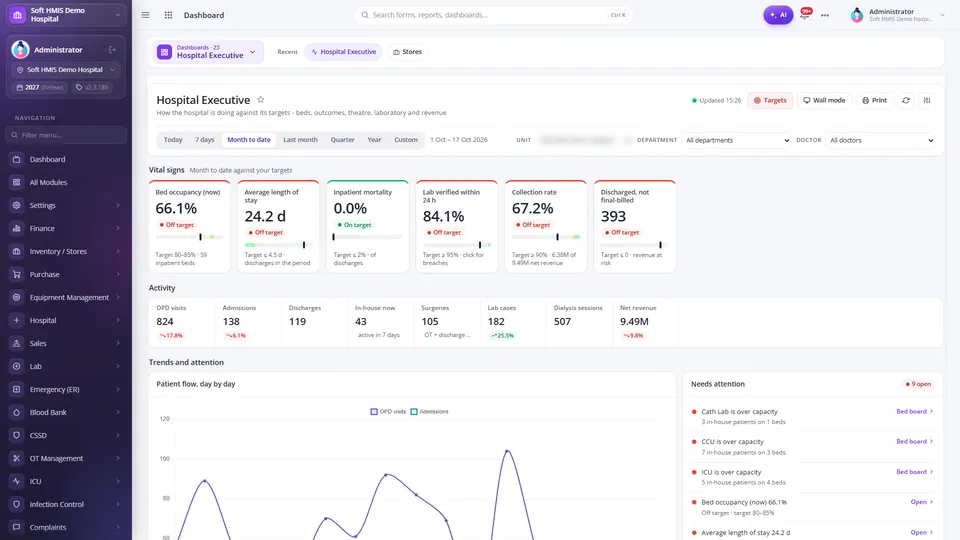
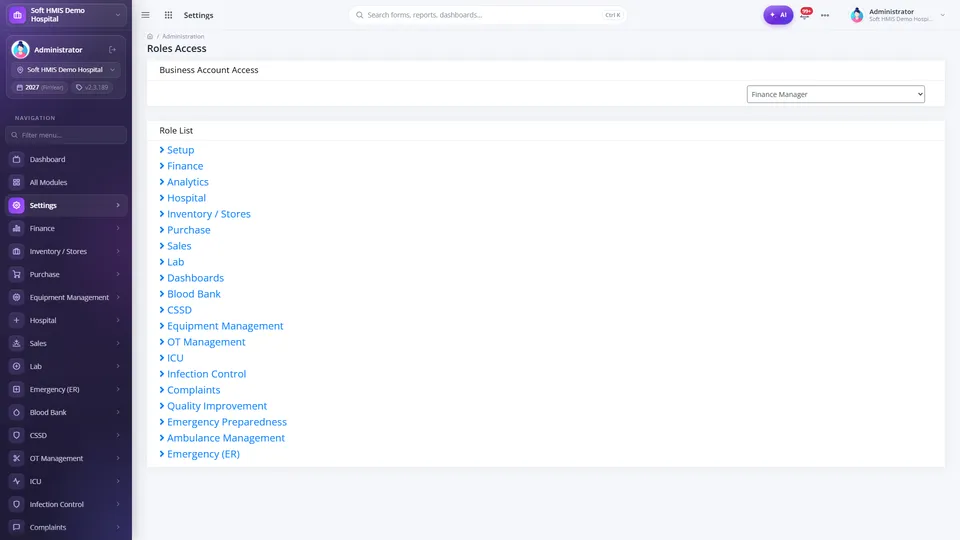
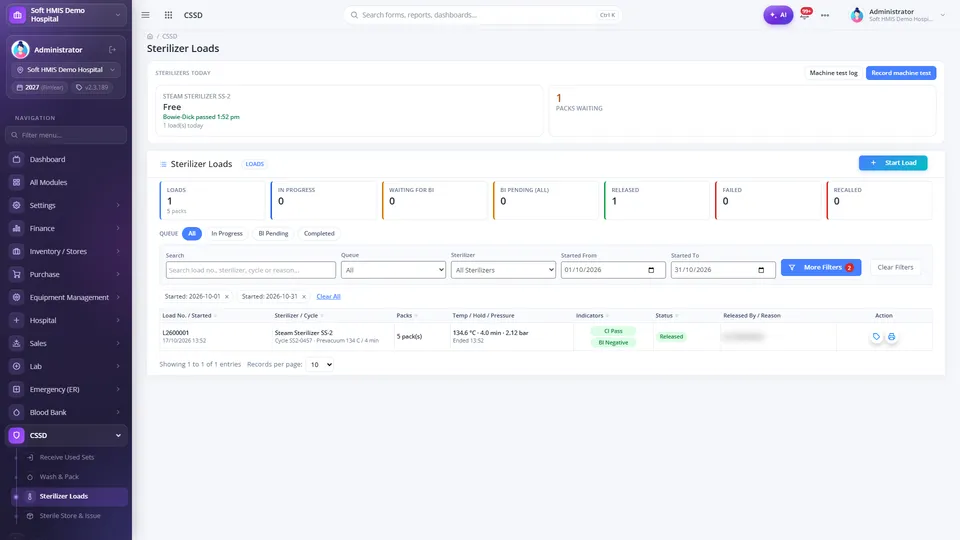
The module set maps closely onto the PHC chapters: patient registration and front desk, the OPD doctor console, emergency, ambulance, IPD and bed management, ICU, operation theatre, dialysis, laboratory with an analyser interface, radiology with PACS, blood bank, pharmacy, CSSD, equipment maintenance, quality and patient safety (incidents, CAPA, KPI register, infection control, complaints, emergency preparedness), billing, finance, inventory and 34 dashboards with drill-down. Each module is switched on per hospital, which suits a phased rollout.
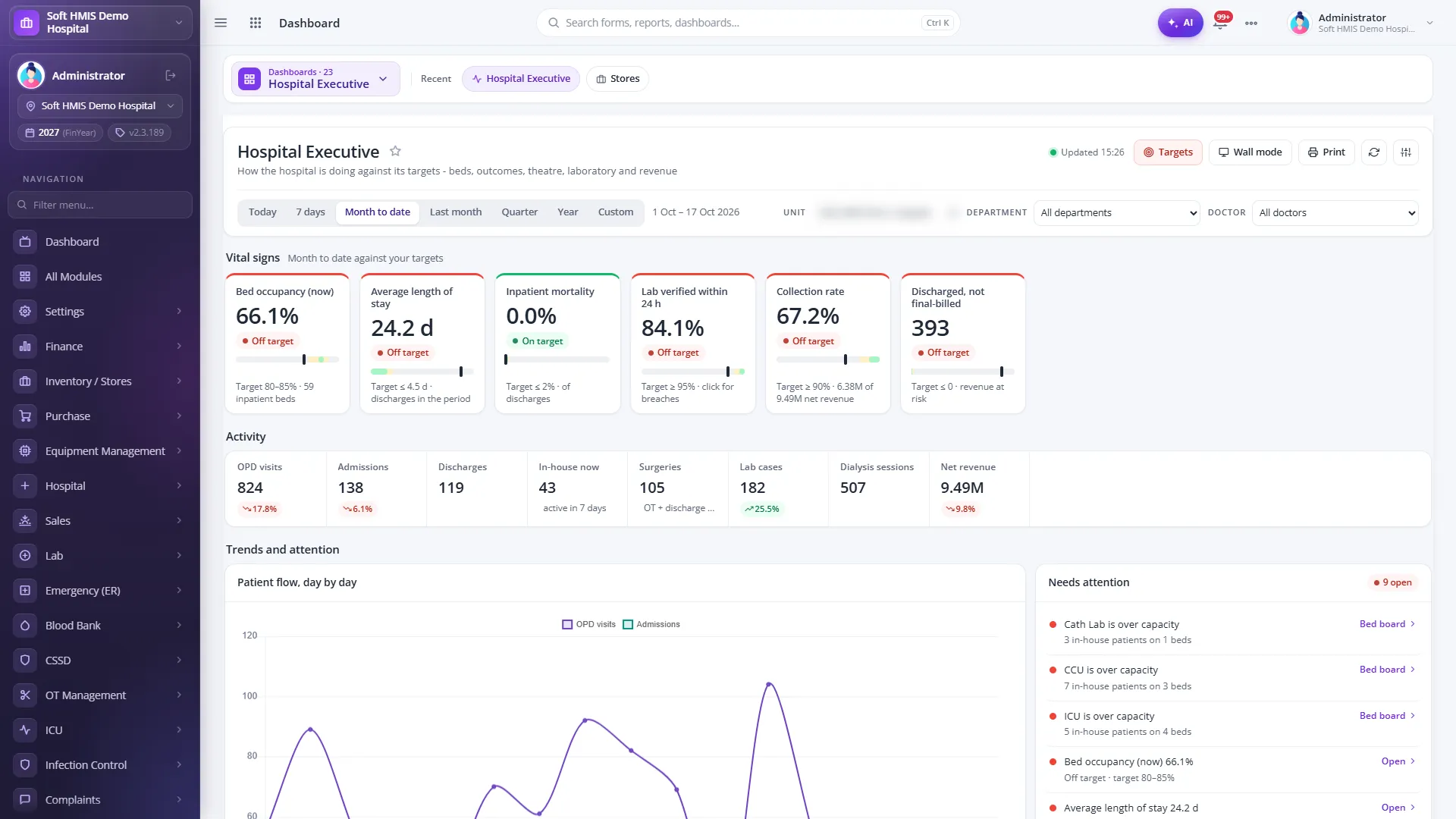
For the data PHC wants to see, the dashboards filter by business unit, date, department and doctor, and every KPI drills down to the rows behind it. Registers and records that inspectors ask for — MLC register, round registers, consents, incident and complaint logs — are produced from the system rather than assembled before an inspection. SoftHMIS is not certified or endorsed by PHC; it is built to make meeting the requirements practical.
Frequently asked questions
Is the PHC HMIS standard mandatory for all hospitals in Punjab?
The report was produced in response to hospitals asking PHC to issue official minimum HMIS requirements for mandatory implementation, and it proposes phased deadlines measured from the date PHC notifies the requirements. Hospitals should treat it as the baseline their software will be assessed against and confirm the applicable notification details with PHC.
What are the PHC HMIS phases and deadlines?
Phase 1 requirements are due within 6–8 months of notification (OPD, emergency, clinical laboratory, radiology, pharmacy and dashboard), Phase 2 within 16–18 months (IPD, OT, ICU, CSSD, equipment, infection control, complaints, CQI, HRM) and Phase 3 within 22–24 months (fire and non-fire emergency management and remaining P3 items).
Does PHC require a specific HMIS vendor or product?
No. The report defines functional requirements and dashboards, not a product. Any system that meets the module requirements can be used. Be wary of vendors claiming PHC “certification” — the document describes requirements, not an approval scheme.
What is the difference between PHC MSDS and the HMIS requirements?
MSDS are the Minimum Service Delivery Standards PHC inspects hospitals against. The HMIS requirements describe the information system that records and reports on that work; the committee treats MSDS compliance as an integral part of the HMIS, so many modules include infrastructure, staffing and SOP requirements that mirror MSDS.
Where should a small or mid-sized hospital start?
Start with the Phase 1 modules — registration and OPD, emergency, laboratory, radiology and pharmacy — on a single patient record, then add IPD, OT and ICU in Phase 2. A gap analysis against the 16-module list is the fastest way to size the work.
Sources
- Hospital Management Information System (HMIS) — Final Report of the HMIS Committee — Punjab Healthcare Commission, 13 June 2026
- PHC
- HMIS standard
- Punjab hospitals
- Compliance
- MSDS