In short
The CSSD module of the PHC HMIS standard requires a hospital information system to track every instrument and tray through the dirty, clean, sterile and storage zones, log each sterilisation cycle with its parameters and outcome, identify items by barcode or QR code, manage expiry and reprocessing, and record the hand-over between the operation theatre and the CSSD. It also covers staff scheduling, consumables, integration with inventory and maintenance, and a CSSD dashboard with cycle, turnaround and quality indicators.
Key takeaways
- Priority-one items include sterilised instrument tracking and location, real-time inventory of sterile items, instrument use documentation in the OT, automatic sterilisation requests, batch tracking and cycle logs.
- Each sterilisation cycle must record the method, date and time, sterilizer ID, parameters (temperature, pressure, time) and success or failure, with alerts and corrective action when a cycle fails.
- Chemical indicator results, sterilizer maintenance and calibration, and environmental conditions in the clean and storage zones are all expected to be logged.
- Expired sterile items should be flagged for re-sterilisation or discard, and every access to a tray should leave an audit entry.
- Transfers from OT to CSSD and dispatch back to OT need timestamps and responsible staff, closing the traceability loop.
What PHC expects a CSSD module to do
The CSSD chapter of the PHC HMIS report (pages 343 to 369 in the final report) is one of the more operational chapters. It is organised around the physical layout of a central sterile services department: the dirty (decontamination) zone, the clean (preparation) zone, the sterile (sterilisation) zone and the storage zone, with further sections on transport between OT and CSSD, process monitoring, storage, the CSSD-to-OT workflow, items used in wards and other departments, consumables, integration, infrastructure, an SOP repository and a CSSD dashboard.
The theme throughout is traceability. PHC wants a hospital to be able to answer, for any instrument set, where it is, which cycle sterilised it, with what parameters, who handled it and which patient it was used on. Paper CSSD registers rarely survive that question; a software module built around barcodes and cycle logs can.
Zone by zone: the requirements
The dirty zone requirements (mostly P2) ask that each item be scanned on arrival with its time and source department, that cleaning equipment such as washer-disinfectors and ultrasonic cleaners be tracked with cycle logs, that worker PPE usage and training be recorded, and that decontamination logs capture the cleaning agent, cycle parameters, equipment and staff involved.
In the clean zone, the system should support inspection and sorting, tag items with unique identifiers, track tray assembly against the required instrument list, record packaging materials, maintain verification logs and raise an alert when an instrument is missing or a tray is incorrectly assembled. Environmental parameters such as temperature, humidity and air quality are also to be logged.
The sterile zone section is where the P2 cycle-tracking requirements sit: automatic capture of temperature, time and pressure for each sterilizer, logging of success or failure with diagnostic detail, the sterilizer type and model, cycle number and time for each tray, scheduled maintenance and calibration with logs, and the results of chemical indicators. Documentation must link each cycle back to the specific instruments and trays sterilised, with automated alerts when conditions were not met.
The storage zone carries the P1 items. Each sterilised tray must be tracked as it enters storage with its real-time location (shelf or cabinet), inventory must be accurate and available in real time, expiry dates must prompt re-sterilisation or discard, and removing a tray for use should update its status to in use and link it to the procedure or patient, with an audit log of who accessed it and when.
Each sterilized instrument or tray should be tracked as it enters the Storage Zone. The HMIS should update its location in real-time.
OT to CSSD and back: closing the loop
Section 3 of the chapter deals with the transfer of instruments and linen between the operation theatre and the CSSD, and most of its items are P1. Every surgical instrument or set used in the OT is to be tagged with a barcode or unique identifier at the initial inventory check, and its use in surgery logged under the patient’s surgical record. After surgery the used instruments go into designated bins and the transfer to CSSD is logged with a timestamp and the responsible staff member.
On arrival a sterilisation request is created automatically, containing the instrument details (ID, type, quantity, set number), the surgery details (patient ID, surgery type, OT staff) and the time of surgery and transfer. Sorting and pre-cleaning are logged, and each batch sent for sterilisation is tracked as a separate entity with its date, time, instruments, cycle parameters and personnel.
Section 6 covers the return journey: requests for sterilised items from CSSD to OT, tracking of dispatched items, the dispatch process itself, communication and feedback between the two departments, and quality control and compliance. Section 7 extends the same idea to wards, ICU, OPD, ER, NICU, CCL, IPD, CCU and LDR, so that items reprocessed for non-theatre departments follow the same request, delivery, usage-documentation and reprocessing cycle.
Process monitoring, consumables and the CSSD dashboard
Section 4 on sterilisation process monitoring repeats the cycle requirements at the level of the whole department: cycle monitoring, automated parameter capture, sterilizer calibration and maintenance, cycle tracking and quality control and inspection. Section 8 adds consumables management for the wraps, pouches, indicators and detergents the department uses, and Section 9 asks for integration with the inventory and maintenance management systems so that stock movements and sterilizer servicing are not recorded twice.
The CSSD dashboard (Section 13 of the HMIS dashboard module) lists what management should see: a real-time overview of sterilisation cycles, turnaround time from collection to completion with alerts on delays, load and tray management by destination, instrument lifecycle history, sterilizer performance and maintenance alerts, a real-time inventory of sterilised items by type, expiry date and batch (P1), staffing per shift (P1), sterilisation validation results, a digital audit trail of every cycle, consumables stock, and KPIs such as average cycle time, instrument turnaround time, sterilisation success rates, equipment downtime and staff adherence to SOPs.
How SoftHMIS supports this
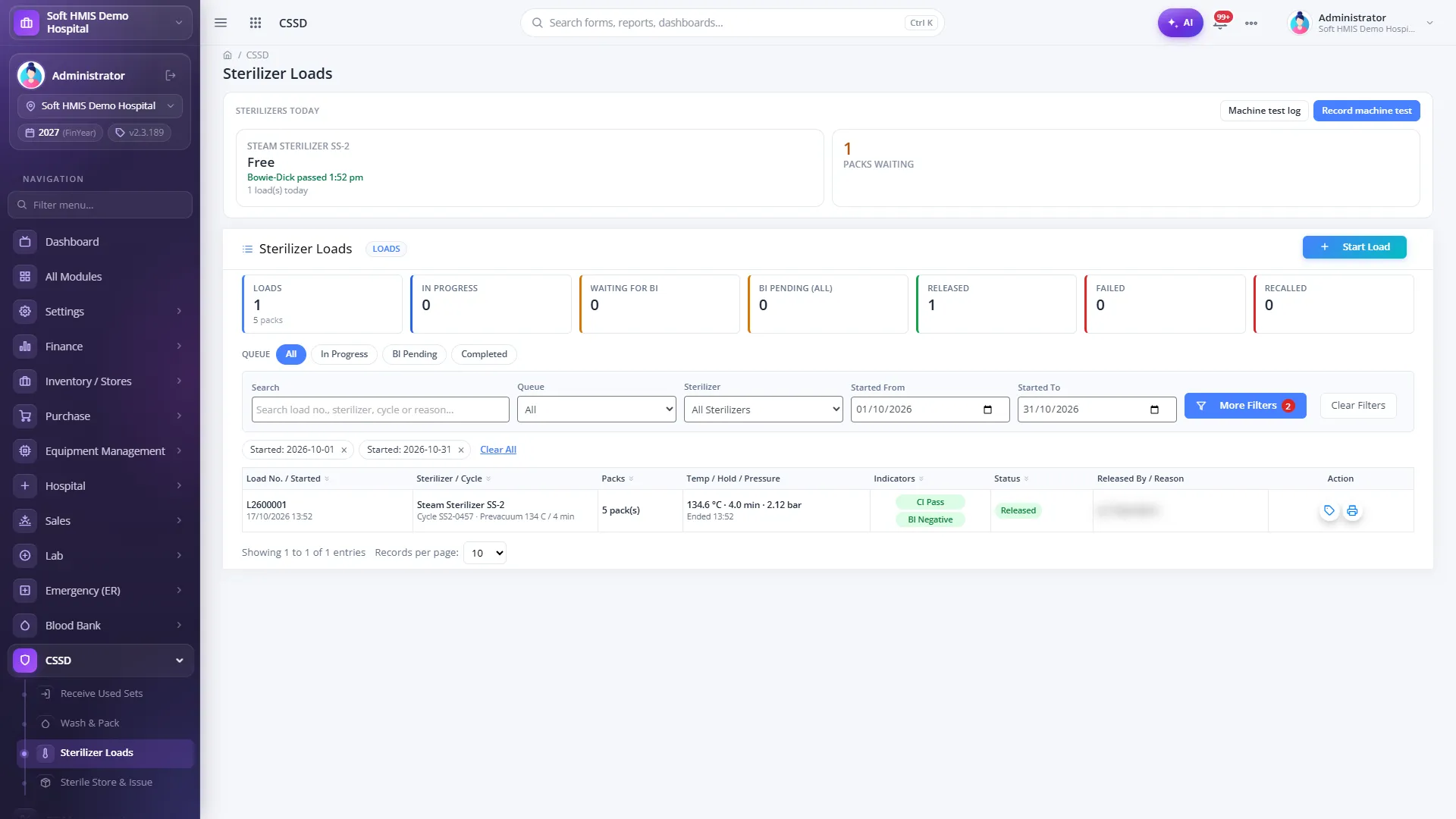
The SoftHMIS CSSD and sterilisation module follows the same loop PHC describes, and is designed around the WHO, AAMI ST79 and ISO 17665 practices the report draws on. Used sets are received by scanning the label, with a count against the instrument list and missing or damaged items noted. Washing is recorded as washer, manual or ultrasonic, and packing includes a per-instrument check.
Sterilizer loads carry a daily Bowie-Dick test. A load is released only when the chemical indicator passes and the required temperature and hold time were reached, and implant loads wait for a negative biological indicator. The sterile store issues packs earliest-expiry first to a department or a patient, with returns, reprocessing and condemning. Every pack has its own barcode and full history, which is the traceability record the storage-zone P1 items ask for.
Recall is built in: a positive biological indicator blocks the load’s packs and lists the departments and patients to follow up. On the theatre side, the SoftHMIS operation theatre module allows instrument sets to be drawn only from the CSSD sterile store, which links instrument use to the surgical record as PHC requires. The module ships gated and is switched on per hospital.
Frequently asked questions
Does PHC require barcode tracking in the CSSD?
Yes. The CSSD module asks for each instrument or tray to carry a barcode or QR code that can be scanned at every step, with individual instruments identified by serial or part numbers where possible, and a centralised database linking instruments to trays.
What must be logged for each sterilisation cycle?
The sterilisation method, date and time, the sterilizer ID or model, cycle parameters such as temperature, pressure and time, and success or failure. Failed cycles must notify staff, record the reason and require corrective action, and chemical indicator results are logged separately.
Which CSSD requirements are priority one (P1)?
Tracking and real-time location of sterilised items in storage, real-time inventory and expiry management, instrument use documentation and post-surgery collection in the OT, automatic sterilisation request generation, sorting and pre-cleaning logs, batch tracking and cycle history.
Does the standard cover instruments reprocessed for wards and ICU?
Yes. Section 7 of the CSSD module extends tracking, sterilisation requests, delivery, usage documentation and reprocessing to items used in wards, ICU, OPD, ER, NICU, CCL, IPD, CCU and LDR.
Sources
- Hospital Management Information System (HMIS): minimum requirements for hospitals in Punjab (final report) — Punjab Healthcare Commission, 13 June 2026
- CSSD
- sterilisation
- PHC
- instrument tracking
- operation theatre